Our clients recently completed a project they'd dreamed of: the addition of a light-filled, first-floor primary bedroom suite.
As we mentioned in our last newsletter, we – like most designers and architects these days – are hearing from more and more homeowners who are interested in having their primary bedroom on the first floor, rather than upstairs.

Windows everywhere and a cathedral ceiling give this first-floor primary suite plenty of light.
The option of "aging in place" in your current home is definitely one reason for this increased interest, but it's not the only one! And on the flip side of the coin, the drawbacks some people fear (noisy living areas, for example) can be reduced or eliminated with good design strategies.
You can find pictures of this lovely first-floor primary throughout this post, and many more in our portfolio, including not only the primary suite but a new living room area as well.
Why first-floor primary suites are popular
One-floor living is convenient in so many ways! Easy access to the shared areas of your house saves the time and effort that stairs always seem to require. And as people get to retirement age and beyond, stairs can become an even bigger obstacle. Many New Englanders want to stay in the house they've loved, and the first-level bedroom suite gives them that option.
Beyond that, the benefits we hear about include:
-
Privacy from older kids (AKA teenagers) who have upstairs rooms – that's a big one!
-
Access for family members with disabilities, including temporary ones like recovering from surgery
-
For those who have the space and funds to build two primary suites, one on each floor, this creates choice for the homeowner and is great for hosting visitors too
-
Resale value – the one-floor living option can make the home appealing to more buyers
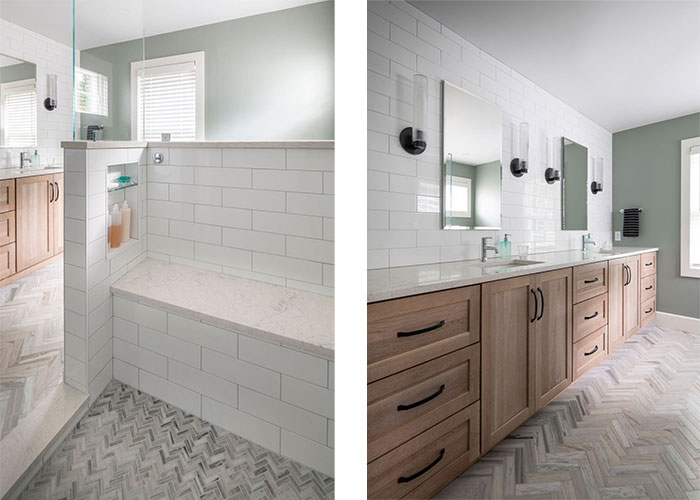
The new primary suite bathroom features his-and-hers sinks, a tile walk-in shower, and lots of drawer space.
Solving the transition from shared space to private space
For the project we are featuring in this post, proximity to other living spaces – both indoor and outdoor – was a really important consideration. The addition features a brand-new living room adjacent to the bedroom suite. The homeowners wanted a graceful transition between the areas, as well as to the new outdoor patio.
The approach we designed is a seating area – great for relaxing, reading, watching TV, or a quiet chat – as a part of the primary suite. This room has a cathedral ceiling (just as the bedroom does) and a cased opening into the living room. The seating area also has big sliding doors to the patio area.
This way, the homeowners don't need a door in the bedroom that goes directly to the outside, or directly into the living room. More privacy, more quiet. They have already gotten a lot of "wow!" reactions to this graceful design from their friends and guests.
(In this picture, you can see the short hallway from this sitting area to the bedroom door, between the sliders and the TV wall.)
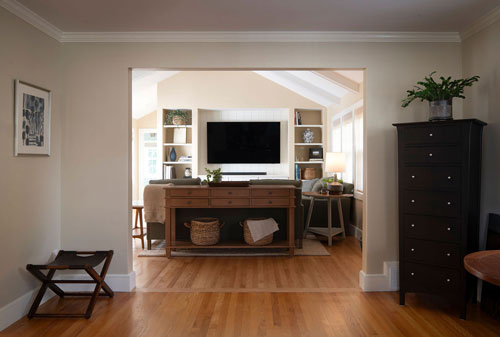
A partially open sitting area makes a great transition from the living room to the primary suite.
Other consideration for making your primary suite exceptional
This recent project illustrates some additional thoughtful touches that can make your first-floor suite not just convenient, but a gorgeous private retreat.
Things to consider for your own primary suite:
Addition or remodeling?
In some homes, it's possible to create a suite by remodeling the existing space (we've done it with great results). Adding an addition, as our clients did in this recent work, may give you more leeway to create exactly the space and layout you want; at the same time, expanding the home's footprint may require new foundation – as we talked about in our post on Value Engineering – and extending plumbing and electrical systems. Whichever approach you choose, it's smart to know the tradeoffs.
Natural light.
Depending on your home orientation and layout, as always, the first floor may require your designer to prioritize bringing in more light. In this case, a bank of beautiful windows at the end of the addition works hand-in-hand with a cathedral or vaulted ceiling to create a light, open vibe.
Storage.
Walk-in closets and built-in shelves and drawers can add style to the space, as well as organization.
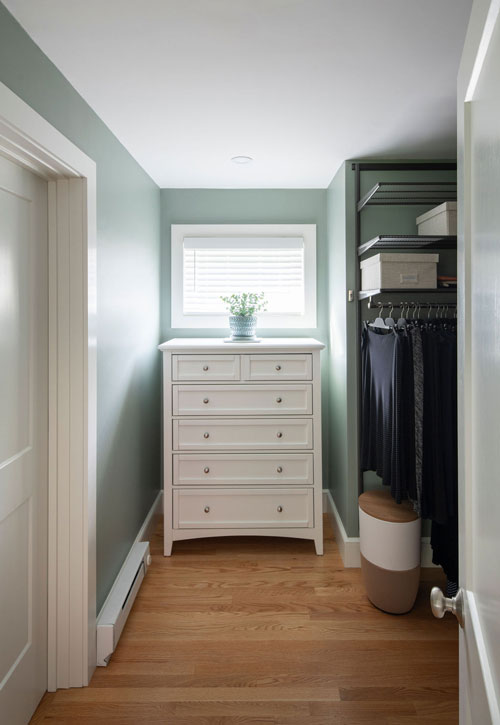
This walk-in closet with its own window adds peace and privacy while bringing in natural daylight.
Privacy.
As our featured project shows, smart design accounts for your privacy, both in terms of sight and sound.
Some projects don't have space available to incorporate a seating area. However, other elements of the suite can still help. A short hallway, strategically placed walk-in closet and ensuite bathroom, and an inner door dividing those areas from the bedroom can buffer sound. Well-built walls also can increase sound insulation. And don't overlook the doors! High-quality doors make a huge difference.
Putting these things together means family members can enjoy the adjoining areas of the home without disrupting the primary suite.
Security.
For those who are used to sleeping upstairs, a move to the first floor can require an adjustment; some people can 'feel' less secure sleeping on the ground level. Quality windows with good locks and sight-blocking window coverings help.
About the author:
GMT Home Designs founder and life-long New England resident Glenn M. Travis has more than 30 years' experience in home design. Learn more about our design/build services.