Accessory dwelling unit (ADU) design and planning services

An accessory dwelling unit (ADU) adds a separate living space to your property – whether for aging relatives, young adults just joining the working world, or even for renters to create extra income for the homeowner.

This can take the form of 

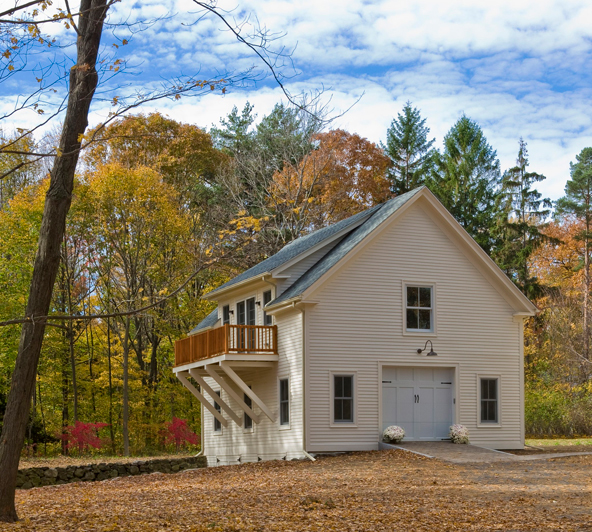
  • a standalone, detached structure
  • a new apartment-style dwelling attached to your primary residence (sometimes called an in-law apartment)
  • or an independent living unit converted from existing space in the home.

From the very beginning of those basic choices, smart planning is your key to ADU success. With more than 30 years of residential architectural experience across New England, GMT Home Designs has guided homeowners through every stage of ADU design and permitting — from initial site feasibility to approved construction documents, for in-home “in-law” units to new detached ADUs to barn and garage conversions. We have the experience and creative vision to help you reach your goals.

Why ADUs start with smart design

For New England homeowners, it's not as simple as dropping a prefabricated ADU in your yard. An ADU starts with great design, from a harmonious look with the rest of the property, through a floor plan that meets real needs for the occupant, all the way to an approved plot plan.

For example, just in Massachusetts, as of 2025, a detached ADU:

  • does not have to be owner occupied
  • is limited to 900 sq ft or less or 50% of the size of the main dwelling – with certain  exceptions by special permit
  • requires a site plan review in some towns, but not others
  • must meet state requirements related to setback, conservation, open space and more

Another set of requirements govern attached ADUs – covering fire separation, sound attenuation, electric wiring, septic and so on. And of course state and local laws are different from the Cape to Rhode Island to Maine and throughout New England.

We're ADU experts – so you don't have to be

You need an expert partner to stay on top of all the laws and requirements that matter for your location, from the start of the ADU project. 

And that's our job. GMT's expert design and architecture team has specialized training and experience designing ADUs that look amazing, "live well," and avoid any speed bumps in the permitting and construction process. 

We love finding creative solutions for New England's unique issues, whether it's 

  • converting a drafty post-and-beam barn
  • complementing a primary residence's style – Colonial, Cape, Tudor, etc
  • solving for setbacks, non-level lots, rocky soil and nor'easters
  • or addressing whatever your specific needs are

Contact us today to discuss your ADU project, or to set up a site consultation to meet at your property to help you know the range of possibilities.
Frequently Asked Questions

An Accessory Dwelling Unit (ADU) is a complete, self-contained living space on your property—separate from your primary residence—with its own kitchen, bathroom, sleeping area, and entrance.

The three main ADU types:

1. Detached ADU (most popular): A standalone structure separate from your main house—essentially a small cottage, carriage house, or "tiny home" on your property.

Advantages: Maximum privacy for both you and occupants, flexibility in design and placement, easier to rent without feeling like someone's living in your house, can be placed optimally on property for views/sunlight.

Challenges: Higher construction costs (separate foundation, utilities, exterior walls), requires adequate yard space, potential setback and lot coverage restrictions.

Typical sizes: 400-1,200 square feet.

2. Attached ADU: An addition connected to your existing home but with completely separate living space—separate entrance, no interior connection to main house.

Advantages: Lower construction costs (shares walls, foundation, utilities), better for smaller lots, easier utility connections, can leverage existing garage or basement space.

Challenges: Less privacy than detached, architectural integration with existing home styling, sound transmission considerations, fire separation requirements.

Typical sizes: 300-900 square feet.

3. Garage conversion ADU: Converting existing garage space (attached or detached) into living quarters.

Advantages: Lowest cost option (structure already exists), faster timeline, doesn't reduce yard space, often easiest permitting path.

Challenges: Lose parking/storage, ceiling height may be limited, may require foundation modifications, must address insulation and moisture issues in unheated garage spaces.

Typical sizes: 400-600 square feet (standard two-car garage footprint).

What ADUs are used for:

Rental income: Long-term rentals or Airbnb/VRBO (where permitted) generating $1,500-$3,000+/month in New England markets

Aging parents: "In-law suite" providing independence while keeping family close

Adult children: Recent graduates, young adults establishing themselves

Home office/studio: Dedicated workspace separate from home life (though technically must include living facilities to qualify as ADU)

Guest house: For frequent visitors without disrupting main house

Caregiver housing: Live-in help for elderly or disabled family members

Multigenerational living: Multiple generations on one property with separate spaces

What makes a structure an ADU vs. just an outbuilding:

ADUs must include full living facilities (kitchen, bathroom, sleeping area) and meet residential building codes. A she-shed, workshop, or office without these features isn't an ADU—it's an accessory structure with different regulations.

ADU regulations vary dramatically across New England states, municipalities, and even specific neighborhoods—navigating this complexity is exactly where GMT's expertise becomes invaluable.

Massachusetts (as of 2025):

State law now allows ADUs by-right (no special permit) in many communities, but significant local variation remains.

For detached ADUs in MA:

  • Maximum 900 square feet OR 50% of primary dwelling size (whichever is greater)
  • Must meet setback requirements (typically 10-20 feet from property lines, varies by town)
  • Adequate lot size (often 5,000+ square feet minimum, varies locally)
  • Cannot exceed primary dwelling height
  • Parking requirements (typically 1 space, some towns waive this)
  • Septic capacity must accommodate additional bedroom(s)
  • Owner occupancy sometimes required (in main house OR ADU)

For attached ADUs in MA:

  • Fire separation requirements (typically 1-hour rated walls)
  • Sound attenuation between units
  • Separate electrical service or proper sub-panel
  • Separate heating systems (or properly zoned)
  • Egress requirements for sleeping areas

Town-specific variations we navigate regularly:

Wellesley, Newton, Needham, Brookline each have slightly different requirements for setbacks, sizes, design review, parking. We know these local regulations intimately.

Rhode Island:

  • Generally ADU-friendly, especially in Providence and coastal communities encouraging housing density.
  • Typically 750-1,200 square feet maximum (varies by municipality)
  • Must be subordinate in size to primary residence
  • Coastal properties may have additional CRMC (Coastal Resources Management Council) requirements
  • Historic districts often require design review for architectural compatibility

Connecticut:

ADU regulations vary significantly by town. Some communities actively encourage them; others impose restrictive requirements.

  • Size limits typically 800-1,000 square feet
  • Parking requirements often stricter than MA
  • Some towns require family relationship between occupants (limiting rental use)
  • Septic capacity major consideration in rural areas without town sewer

New Hampshire:

  • Generally more permissive on private property rights but with local control.
  • Size and setback requirements vary by town
  • Septic approval critical (significant portions of NH on private septic)
  • Some towns have no specific ADU regulations (treated as accessory structures)
  • Shoreland protection rules if near water bodies

Vermont & Maine:

Less dense populations mean ADUs are less common, but rural areas often have more flexible regulations. Environmental considerations (wetlands, water resources) can be more restrictive.

Common regulatory hurdles across New England:

Septic capacity: If you're on private septic (not town sewer), adding bedrooms requires either system expansion or certification that existing system has adequate capacity. This is often the most expensive ADU challenge, potentially $15K-$40K for new/expanded systems.

Setbacks and lot coverage: Even where ADUs are allowed, your property must have sufficient space meeting setback requirements and not exceeding maximum lot coverage percentages.

Wetlands and resource areas: Properties with wetlands, vernal pools, rivers, or protected habitats face additional restrictions on where structures can be located.

Historic districts: Properties in local or national historic districts face design review ensuring ADUs are architectically compatible with existing structures and neighborhood character.

HOA restrictions: Some homeowner associations prohibit or restrict ADUs beyond municipal regulations. Check your deed and HOA bylaws.

Zoning variances: If your property doesn't meet standard requirements, you may need variances—a longer, more uncertain approval process requiring presentations to zoning boards.

GMT's role in navigating regulations:

We research specific requirements for your property location, design ADUs that comply with all applicable regulations, prepare documentation for permit applications, and guide you through the approval process.

We've designed ADUs across dozens of New England municipalities and know which towns are ADU-friendly, where challenges typically arise, and how to position projects for successful approval.

Don't DIY this research: ADU regulations are complex, change frequently, and involve multiple layers (state, local, environmental, historic). Professional guidance prevents expensive mistakes like designing an ADU that can't be permitted or discovering mid-construction that additional approvals were required.

ADU construction costs in New England typically range from $150-$350 per square foot depending on type, finishes, site conditions, and location—meaning total projects from $75K for garage conversions to $350K+ for high-end detached units.

Realistic cost breakdown by ADU type:

1. Garage conversion ADU (400-600 sq ft):

Low-end (basic finishes, DIY-friendly): $75K-$120K ($150-$200/sq ft)

Mid-range (quality finishes, full professional construction): $120K-$180K ($200-$250/sq ft)

High-end (luxury finishes): $180K-$250K ($250-$350/sq ft)

Includes: Insulation, heating/cooling, electrical, plumbing, kitchen and bathroom fixtures, flooring, finishes. Foundation work usually minimal since structure exists.

2. Attached ADU (500-800 sq ft):

Low-end: $100K-$150K ($175-$225/sq ft)

Mid-range: $150K-$225K ($225-$275/sq ft)

High-end: $225K-$325K ($275-$350/sq ft)

Includes: Foundation (shared with main house), framing, exterior finishes matching existing home, complete interior build-out, utility connections.

3. Detached ADU (600-1,000 sq ft):

Low-end (simple design, basic finishes): $150K-$225K ($200-$250/sq ft)

Mid-range (thoughtful design, quality finishes): $225K-$325K ($250-$300/sq ft)

High-end (custom design, luxury finishes, high-performance): $325K-$500K ($300-$400/sq ft)

Includes: Site work, foundation, complete structure, all utilities from main house to ADU, septic connection or expansion, landscaping restoration.

What drives ADU costs higher:

Site challenges: Steep slopes requiring retaining walls or engineered foundations, ledge necessitating blasting, difficult access for equipment, significant distance from utilities.

Septic system work: New or expanded septic systems ($15K-$40K+), particularly expensive in areas with poor soils or limited space.

Utility extensions: Running electrical, water, sewer significant distances from main house to detached ADU location.

Foundation complexity: Full basements, challenging soils, high water tables, frost protection requirements.

High-end finishes: Custom cabinetry, stone countertops, hardwood floors, high-end fixtures, architect-designed custom details.

Energy performance: Super-insulated envelopes, high-efficiency HVAC, solar-ready design, Passive House standards.

Design complexity: Custom architectural features, complex rooflines, extensive windows, premium materials.

Location factors: Boston metro area and coastal communities = higher end of cost ranges. Rural areas or less expensive regions = lower end.

Costs beyond construction:

Design/architectural fees: $8K-$25K depending on complexity (typically 8-12% of construction costs)

Engineering: $2K-$8K for structural, septic, or other specialty engineering if required

Permitting and fees: $1K-$5K depending on municipality

Utility connections: $0-$15K if utility company work required (running lines to property, service upgrades)

Landscaping restoration: $3K-$10K replacing lawn, plantings, hardscaping disturbed during construction

Unexpected conditions: Budget 10-15% contingency for unforeseen issues (which can include ledge, old foundations, contaminated soils)

ROI considerations:

Rental income: New England ADUs can generate $1,500-$3,500/month depending on location, size, and quality.

Boston metro suburbs: $2,000-$3,500/month

Providence area: $1,500-$2,500/month

Smaller cities/towns: $1,200-$2,000/month

Short-term rentals (where allowed): Often 30-50% higher income, but more management required

Property value increase: ADUs typically add 20-30% of their construction cost to property value immediately, with appreciation over time.

Payback timeline: With rental income of $2,000/month ($24K/year) on a $200K ADU investment, simple payback is roughly 8-10 years—but property value increase and tax benefits improve actual returns significantly.

GMT's cost-management approach:

We design ADUs that maximize value within your budget—right-sizing spaces, selecting appropriate finishes, designing efficiently to minimize waste, and coordinating with builders early for accurate pricing. We help you understand trade-offs so you invest wisely in features that matter most.

Technically you can attempt ADU design yourself in some jurisdictions, but the complexity of regulations, code requirements, and construction coordination makes professional architectural design a practical necessity for successful ADU projects—and often legally required.

When you legally need an architect:

Massachusetts: Projects over certain square footage or complexity thresholds require a registered architect stamp on plans (specifics vary by building department).

Complex structural work: Any significant structural engineering requires professional involvement.

Historic districts: Design review boards typically require professional architectural drawings.

Special permits/variances: Zoning board applications almost always require professional plans to be taken seriously.

Many municipalities: Building departments require architect or engineer-stamped drawings for ADU permits regardless of size.

Why DIY ADU design usually fails (even where legal):

Code compliance complexity: Building codes for habitable spaces are extensive—egress requirements, fire ratings, structural calculations, energy code compliance, accessibility considerations. Missing requirements causes permit rejections or failed inspections.

ADU-specific regulations: Each town's ADU bylaws have unique requirements (setbacks, height limits, size caps, parking, design standards). Getting these wrong means permit denial after you've invested design time.

Septic engineering: If on private septic, you'll need Title 5 engineer certification regardless—can't DIY this. Coordinating ADU design with septic capacity/expansion requirements needs professional input.

Construction documentation: Contractors need detailed plans to bid accurately and build correctly. DIY sketches lead to vague bids, misunderstandings, change orders, and frustration.

Utility coordination: Properly sizing electrical services, routing plumbing, designing HVAC systems requires technical knowledge most homeowners lack.

Spatial design: Creating functional, comfortable 500-800 square foot living spaces is harder than it seems. Poor layouts waste space, feel cramped, or don't function well. We've redesigned many DIY attempts that "seemed fine on paper" but didn't work in reality.

Permitting navigation: Building departments ask technical questions during plan review that DIYers struggle to answer, causing delays, multiple resubmissions, or outright permit denial.

What homeowners CAN do themselves:

Preliminary research: Understand your local ADU regulations, research design ideas, develop general vision for what you want.

Program development: Determine size, bedroom/bathroom count, must-have features, budget parameters.

Inspiration gathering: Collect design ideas from Houzz, Pinterest, ADU specialty websites.

Site analysis: Identify potential ADU locations on your property, consider sun exposure, views, privacy.

Then hire professionals to translate your vision into compliant, buildable, functional design.

The cost-benefit calculation:

DIY design appears to save: $8K-$20K in architectural fees.

DIY design often costs:

Permit delays (months of lost rental income if building for investment)

Construction inefficiencies from vague plans ($5K-$15K)

Mistakes requiring correction ($3K-$10K+)

Missed opportunities for better layouts/functionality (ongoing quality-of-life impact)

Risk of permit rejection requiring professional redesign anyway (pay twice)

Professional design provides:

Code-compliant plans that pass review first time

Efficient layouts maximizing limited square footage

Coordinated permit applications and approvals

Buildable documentation contractors can accurately price and execute

Problem prevention through experience

GMT's ADU expertise specifically:

We've designed dozens of ADUs across varied New England municipalities, understand regulatory variations, know common pitfalls, design efficient small-space layouts, and coordinate the complex approval processes.

Our site consultation ($250-$500) often saves thousands by identifying feasibility issues early—septic constraints, setback problems, zoning challenges—before you invest in design that can't be permitted.

Bottom line:

ADUs are complex projects where professional design isn't optional luxury—it's a practical necessity ensuring your investment succeeds. We've never had a client tell us they regretted hiring us. We've fixed many DIY attempts where clients wished they'd started with professionals.