Next in our series spotlighting local New England cities and towns: Our nearby neighbor of Providence, Rhode Island.
Designing homes in and around Providence has been inspiring for us at GMT, partly because the city features such an exceptional number of different architectural styles, from very old to very modern.
Proximity to so much waterfront – rivers, lakes, and bays – is also a part of the area's appeal. (Also, as any local knows, you can get a great meal any and every time you're in Providence!)
As with so much of New England, understanding Providence's mixed architecture means taking a quick peek into the city's history.
We'll start downtown and then venture out into some of the city's vibrant and varied residential neighborhoods, as well as a few towns nearby.
What architectural styles are common in Providence's downtown? Providence is super eclectic architecturally, which is one of the things that makes it so fun and interesting.
The downtown features Victorian and Art Deco buildings, together with some more modern styles, as well as important Federal and Georgian Revival buildings from the city's early commercial days. And the occasional odd Brutalist-style piece like the Providence Civic Center (built in '72).
How did the Great Fire of 1825 affect the downtown architecture? Providence has suffered a few fires over the centuries, which led to new building codes requiring brick and stone construction. So that's why downtown has fewer wooden structures compared to residential areas.
Why are so many Victorian buildings and homes still intact in Providence? Providence avoided a lot of the urban renewal that destroyed historic districts in other cities during the mid-1900s (mostly due to Providence being economically depressed during that time period; the city's population dropped by about 30% from 1940 to 1970). That preserved significant chunks of its 19th-century architecture.
More recent downtown construction or revival efforts – and obviously there have been some big ones, like "relocating" where the rivers meet in the early 1990s! – have tended to balance historical preservation with new development. For example, the original proposed design of the Providence Place mall was rejected and ultimately the developers created something more architecturally in tune with the existing buildings around downtown.
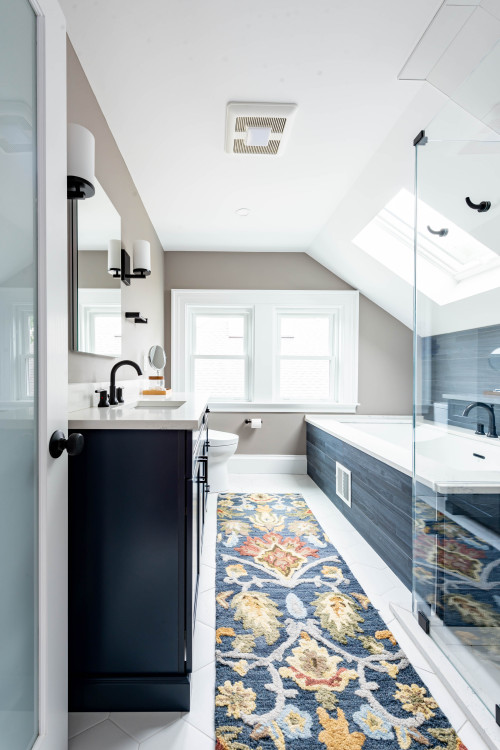
GMT's design for this whole-house interior remodel updated the eclectic craftsman-esque home in Providence while retaining its unique charm.
What's the story behind the Industrial Trust Building? This 1928 Art Deco skyscraper (AKA "the Superman building"), close by the iconic Biltmore hotel, was Rhode Island's tallest building for decades and features distinctive setbacks and ornate lobby details. It was vacant for many years, and considered an "endangered" historical building. Now we're glad to see it is being cleaned up to be converted into a mix of residential units and commercial space.
What makes the State House dome so distinct (and famous)? It's one of the largest self-supporting marble domes in the world. The 11-ft-tall bronze "Independent Man" statue up top was created by George Brewster, who taught (briefly) at RISD in the late 1800s.
What's unique about the First Baptist Church in America? Built in 1775, its wooden steeple required innovative engineering techniques, and the interior features box pews and a wine-glass pulpit that reflect colonial craftsmanship.
What's a “piazza” in Providence? Those densely built, three-story, multi-family wooden houses found in many neighborhoods often have a distinct, covered front porch. That's what is known locally as a piazza.
Many of these homes were originally built for Italian immigrant families, which you might guess from the awesome restaurant scene in Federal Hill, AKA Little Italy. (Pizza strips for the win.)
Hence the Italian term for this porch, which literally means "square." In densely built neighborhoods, families could easily talk from their piazza to their neighbors', or watch kids playing in the street, so it was a semi-private, semi-social part of the home.
How do you identify a "Providence cottage"? These are small, 1.5-story homes typically with steep-pitched roofs, central chimneys, and minimal ornamentation—built for working-class families in the early 1900s.
What architectural details do people often miss? Look for carved stone faces on Victorian buildings, decorative corbels under eaves, and original slate sidewalks with property owner names embedded in them.
Why all the different front door colors on Wickenden Street? It's a tradition that Portuguese immigrants originally brought into the Providence melting pot – brightly colored doors on colonial and Victorian homes became part of the Fox Point area's identity. And some property owners continue it today. It really adds a great vibe to these neighborhoods.
Are East Providence and "the East Side" the same thing? No indeed, and this sometimes confuses visitors (just like Southie and the South End, two different parts of Boston).
East Providence or EP is an independent city with its own mayor, city council, school system, police and fire departments, et cetera. It's across the Seekonk River from Providence proper. Compared to the East Side, EP is more suburban, and built up more after the 1920s — with wider streets, less housing density, and lots of ranch-style houses, split levels, and Capes.
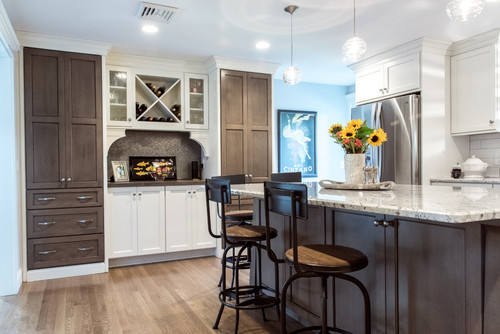
GMT designed this remodeled kitchen in East Providence, with rich brown woods bringing a cozy feeling within a bright, clean space.
Providence's "East Side" refers to neighborhoods that are inside Providence city limits, including the Hill, Wayland, Hope, Mount Hope, and Blackstone areas near Brown University and RISD. The East Side is where you'll find a ton of Victorian homes with decorative trim and big wraparound porches, along with an eclectic mix of Gilded Age mansions, shingle style homes, and "arts and crafts" bungalows — which can be bigger and more elaborate than the Providence Cottages that are more prevalent in Federal Hill and Smith Hill.
Are construction and remodeling difficult in Providence?
Like most New England cities, Providence has a central historic district with its own extra layers of approval, permitting and construction requirements. That adds time and expense to renovations as well as new construction. But as we say, that's common in our cities.
Outside that historic district, the challenge also varies by neighborhood and in adjacent towns. Generally speaking, it's not unusually expensive to build, renovate or remodel here, compared to other New England cities.
What towns outside Providence are in the most demand, in terms of homes?
Barrington, south of EP, is quite desired as reflected by its average home value (above $800,000) – which reflects lower housing density, high-rated schools, and easy access to the Providence River and Narragansett Bay. There are quite a few gorgeous luxury waterfront homes in and around Barrington. In addition to custom homes this town has lots of capes and different kinds of colonials and Victorians, still varied but with less eclectic mixing of styles than in Providence itself.
A little further outside of the city, and on the west side of the bay, the region around North Kingstown offers similar benefits at somewhat lower cost (average home value around $650,000). North Kingstown, like Barrington, leans toward colonial and Victorian homes.
Buildable open lots are hard to find in this whole area south of Providence, particularly on the waterfront, so remodeling, renovation and new addition projects are more common these days as opposed to brand new construction homes.
***
About the author: GMT Home Designs offers architectural design services in Providence, East Providence, Kingston and surrounding towns. Founder Glenn M. Travis has designed custom homes and remodels all over Rhode Island and throughout New England, from cities to waterfronts to suburbs and farms. Reach out to us at info@gmthomedesigns.com.
Photo by Rafael Rodrigues on Unsplash